Blog articles
How to Write Song Lyrics: A Complete Beginner's Guide (2026)
Step-by-step guide to writing song lyrics for beginners. Master theme, structure, rhyme schemes, hooks, and editing — then turn your lyrics into a real song with AI.
You do not need to wait until you feel talented to write your first lyric. You need something to say, a small structure to hold it, and permission to write a rough version. A lyric is a draft you can improve—not a test you either pass or fail.
The short answer: choose one moment, write a verse that makes us see it, give the chorus one clear message, and read everything aloud. Then revise the words against a melody. This guide takes you through that process with original examples and exercises you can try today.
1. Start With a Theme — What Do You Want to Say?
“Love” is a subject. “I still cook enough dinner for two after you moved out” is a song idea. The second gives you a person, an action, and a tension. Start that small.
A personal story supplies details: a chipped mug, the last bus, a coat nobody collects. A universal feeling gives those details meaning: longing, relief, jealousy, belonging. You do not have to choose between them. Use the personal scene to carry the feeling.
Try a three-minute brainstorm
Set a timer and answer this prompt without rhyming:
Think of a moment you wish you could revisit. Where were you? What object was within reach? What did you want to say, and what did you say instead?
- Minute 1: list objects, sounds, actions, and unfinished thoughts.
- Minute 2: circle three details that belong to this particular moment.
- Minute 3: complete “This song is about ___, but underneath it is about ___.”
Example: “This song is about missing the last train, but underneath it is about being afraid to go home.” Your working keyword list might be empty platform, cold coffee, unanswered call. Keep it beside your draft.
Toolbox: enter your scene and keywords into the AI Lyrics Generator, choose a genre and mood, and use a generated draft to discover phrases worth developing. The tool creates lyrics; it is not a dedicated keyword extractor. If your starting idea is vague, describe the situation first, then pull useful images from the draft yourself. Sign-in is required to generate.
2. Build Your Song Structure
Structure gives each section a job. It also saves you from trying to say everything in the opening four lines.
| Section | Its job | A useful question |
|---|---|---|
| Verse | Develop a scene, event, or detail | What happened, and what changed? |
| Chorus | Return to the central emotional message | What should the listener remember? |
| Bridge | Introduce a contrast or realization | What do I understand differently now? |
| Pre-chorus, optional | Build expectation before the chorus | What tension needs a release? |
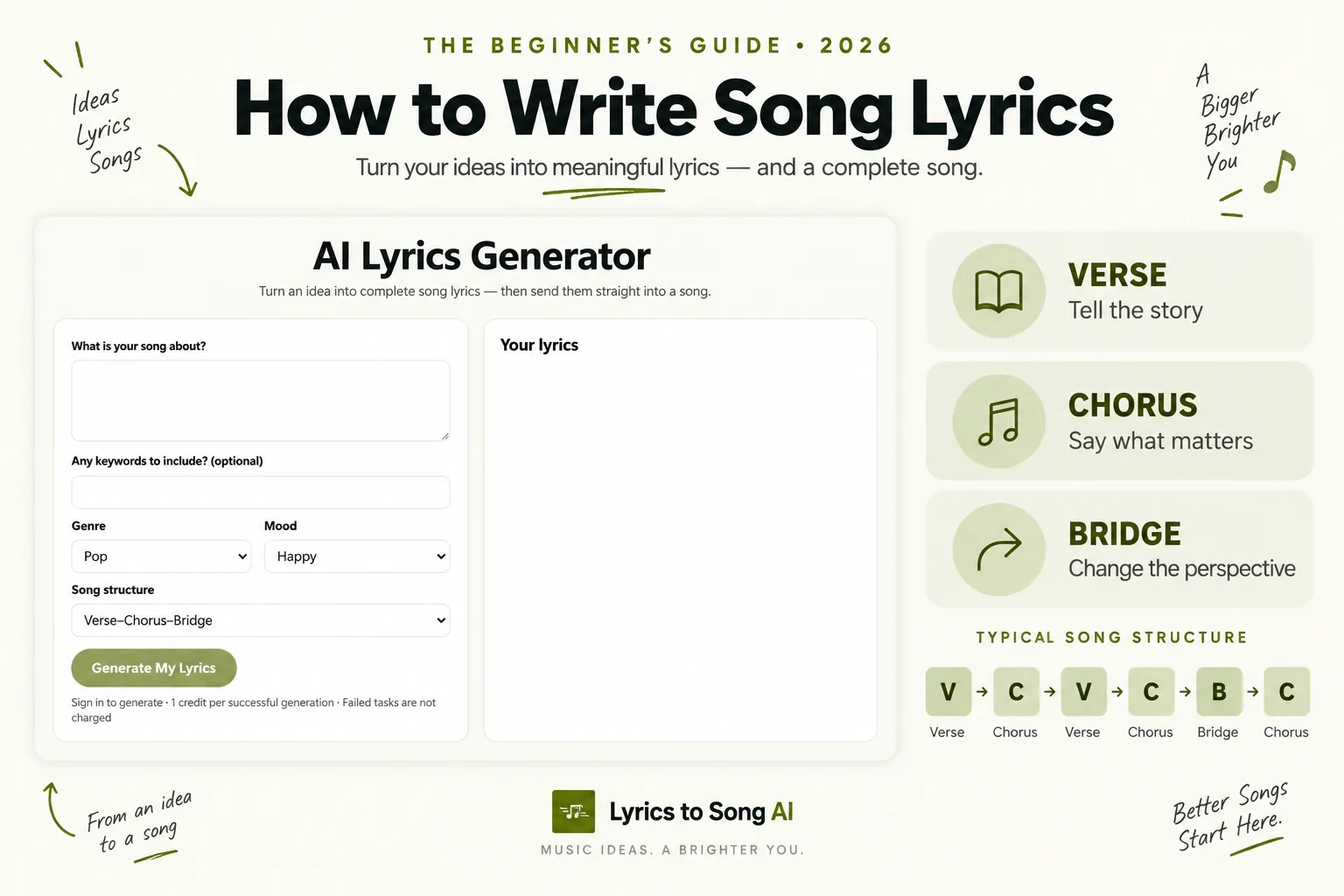
Try Verse–Chorus–Verse–Chorus–Bridge–Chorus, or V–C–V–C–B–C, for your first draft. Verse one sets the scene; verse two must add something. The bridge changes the angle before the chorus returns.
A shorter V–V–C–C sketch can work too: two verses develop the situation, then the chorus repeats to close. It is an option, not a rule or a claim that most songs use this form. Add an intro, pre-chorus, or outro only when you hear a reason for it.
Listening example: “Shake It Off” by Taylor Swift
For a beginner's listening map, notice the opening beat, the verse, the build into the chorus, another verse/chorus cycle, a contrasting bridge, and the returning chorus material. Listen for the change in delivery in the bridge rather than trying to force every second into six equal boxes. This is a simplified map, not a bar-by-bar score.
Hit Songs Deconstructed's analysis examines the song's repeated hooks and the relationship between its sections. Our practical takeaway: repetition gives the listener a familiar destination; contrast makes arriving there feel rewarding. You can borrow that principle without borrowing its lyrics or melody.
3. Master Rhyme Schemes (Without Sounding Forced)
Letters describe the sounds at the ends of lines. Matching letters rhyme; they do not have to use the same spelling. Say the words aloud—love and move look similar but do not rhyme in standard English pronunciation.
| Scheme | Line-ending example | Effect to try |
|---|---|---|
| AABB | light / night / rain / train | Two close, satisfying pairs |
| ABAB | light / rain / night / train | A rhyme that returns after a gap |
| ABCB | door / rain / cup / train | More freedom; only lines two and four must rhyme |
Perfect rhyme is only one choice. Near rhyme, repeated consonants, and internal rhyme can connect phrases more subtly. A near rhyme such as home / alone can work in a performance even though the ending sounds are not identical. Judge it by singing, not spelling.
The most common trap is writing something you would never mean just to reach the rhyme word. If your character waits for a bus, do not suddenly invent a train because it rhymes with rain. Change the line, the rhyme, or the scene deliberately.
Exercise: turn a plain paragraph into AABB
Start with this deliberately unrhymed draft:
I waited by the kitchen window. The food was getting cold. Your coat was still beside the door. I did not know whether you would return.
Keep its emotional facts but reshape it into four lines. One original answer:
I left the hallway burning bright.
Your coat kept watch with me all night.
The supper cooled; I called your name.
The morning knocked. You never came.
Here bright/night forms A and name/came forms B. Notice the tradeoff: the window disappears and the hallway takes its place. Revision may change details, but it should preserve the feeling you meant.
Tomorrow, compare your answer with a rhyming dictionary or an AI rhyme tool you already use. Treat suggestions as possibilities, and check pronunciation yourself. There is no dedicated rhyme finder on this site at present.
4. Write Vivid Lyrics — Show, Don't Tell
An emotion tells us what to think. A detail lets us experience it. “I'm sad” becomes more tangible in “The room felt heavy,” but heavy is still an impression. “Your cup went cold beside my own” gives the singer an object and a moment.
| Abstract line | Original concrete alternative |
|---|---|
| I miss you. | I set two plates, then put one back. |
| I am nervous. | I fold the ticket till the ink comes off. |
| I feel free. | I leave my shoes beside the tide. |
These are alternatives, not automatic upgrades. A direct sentence can be exactly right in a chorus. The skill is choosing when to show a scene and when to name its meaning. Andrea Stolpe's Berklee lesson on imagery offers a useful way to connect sensory verses with a broader chorus message.
Rewrite three abstract lyrics
Rewrite “I am lonely,” “I am angry,” and “I am hopeful.” For each one, choose a place, an object, and an action. Avoid the emotion word in your first attempt. Then compare a version that names the feeling with one that leaves it implied. Keep the one that serves your song.
Do not load every line with five senses. One telling detail is often stronger than a catalogue. You can hear the refrigerator hum in an empty kitchen without also describing its color, temperature, smell, and taste.
5. The Hook — Make It Unforgettable
A hook is the part you remember and want to hear again. It may be a lyric, a melody, a rhythm, or a combination. Your title is a good starting place, but a title is not automatically a hook.
Aim for something singable (natural stresses and room to breathe), specific (a clear emotional angle), and surprising (a fresh turn of phrase or contrast). A hook need not maximize all three. Simplicity can be the strength.
Five classic hooks to study
The following are our listening interpretations, not formulas or claims about the writers' intentions. Follow the linked recordings or commentary and listen without copying the words.
| Song | Why the hook is worth studying | Try this in your own draft |
|---|---|---|
| “Shake It Off” — Taylor Swift | An active title and repeated rhythmic delivery turn a response to criticism into a physical gesture. | Make your central idea an action. |
| “Hey Jude” — The Beatles | Direct address feels personal; the extended closing refrain invites participation. | Imagine singing to one specific person. |
| “Let It Be” — The Beatles | A compact, conversational title gives a complicated feeling a simple place to land. | Reduce your message to one natural sentence. |
| “We Will Rock You” — Queen | Short words and a strong shared pulse make the central phrase easy to join. | Clap a rhythm and see whether your words fit it. |
| “Another One Bites the Dust” — Queen | The title's rhythm and the bass groove reinforce each other; the phrase suggests a continuing story. | Test the hook against a repeated pulse, not only on paper. |
For our empty-kitchen example, a working hook could be “I still make room for you.” It links a physical action with an emotional habit. Repeat it twice over a simple melody. If you need to rush through still make room, remove a word or change the rhythm.
6. Edit Like a Pro — The Rewrite Phase
Leave the draft for 24 hours if you can. The pause is a practical habit, not a scientific threshold: it helps you return as a listener rather than defending every word you just wrote.
Read the lyric aloud in a normal speaking voice. Then sing it over a simple pulse. Mark places where you swallow syllables, put emphasis on an unimportant word, or run out of breath. Similar syllable counts can help parallel lines, but matching natural stresses matters more than making every count identical.
Ask a friend two concrete questions: “What do you think this song is about?” and “Which line stayed with you?” Their answers are more useful than asking whether the lyric is good.
Ask three questions of every line
- Does it belong? Does it develop the scene or the central message, rather than repeat information accidentally?
- Can I sing it naturally? Are the important words stressed, and is there breathing room?
- Is this my clearest wording? Did I choose a word for its meaning, or only because it rhymes?
Keep a copy before editing. Cut filler, replace one vague verb, and check that verse two moves the story. Rewrite in passes—meaning first, singability second, rhyme last—so that polishing a rhyme does not protect a weak idea.
7. From Lyrics to a Real Song — Modern AI Workflow
Lyrics are one part of a song. A melody gives them pitch and phrasing; chords supply harmonic movement; arrangement decides how voices and instruments enter. You can develop those parts yourself, collaborate with a musician, or use AI to explore a musical setting.
| Traditional route | AI-assisted route |
|---|---|
| Sing possible melodies, try chords on an instrument, and arrange or record with collaborators. | Describe a musical direction and generate a candidate you can listen to and evaluate. |
| You can make deliberate note-by-note choices as your skills and tools allow. | You can test ideas without writing every note, but outputs may miss your intended phrasing or direction. |
Use Lyrics to Song AI step by step
- Prepare lyrics you have the right to use. Separate verses and choruses clearly. You can draft manually or start with the AI Lyrics Generator.
- Open the song creation workspace and sign in. Paste your draft, or use the lyrics tool's send-to-song action after generating and reviewing its result.
- Choose a musical direction. Set genre, mood, voice, and the available slow, medium, or fast tempo option. These are directions for generation, not a promise of exact BPM or note-level control.
- Review and generate. Check your lyrics and the displayed credit requirements before submitting. Generation requires login, including when using free credits; it is not an instant one-click export.
- Listen, then keep what works. Compare the returned candidates. Notice rushed words, unclear sections, and whether the chorus feels distinct. Revise your lyric before starting another generation if needed.
- Download an available saved result from your library. Availability and rights depend on that result and its account entitlements. Do not assume an AI output automatically grants unrestricted commercial use.
Use the first result as feedback. If the singer crams a sentence into one breath, shorten it. If the chorus sounds like another verse, simplify its language and repeat the central idea. A useful demo is a step in the writing process, not proof that the lyric cannot improve.
Common Mistakes Beginners Make
- Writing about everything at once. Pick one scene and one emotional turn. Save the other story for another song.
- Choosing the rhyme before the meaning. Write the plain sentence first, then explore ways to sing it.
- Making every section identical. Let verses add detail and the chorus return to the message. Change perspective in the bridge.
- Ignoring the mouth and breath. Speak and sing the draft; a line that looks elegant can still be awkward to perform.
- Treating the first draft—or first AI output—as finished. Replace generic phrases with details you chose, and revise after listening.
Quick-Start Challenge: Write Your First Verse in 10 Minutes
You only need a timer and somewhere to write. The goal is four usable lines, not a finished hit.
- Minutes 0–2: choose one moment. Write “I am in ___, waiting for ___.”
- Minutes 2–4: list three visible objects and one sound. Circle the detail with the most emotional weight.
- Minutes 4–6: write four plain sentences: where you are, what you do, what is missing, and what you decide.
- Minutes 6–8: shorten those sentences into lines. Try ABCB or leave them unrhymed if rhyme gets in the way.
- Minutes 8–10: read aloud, remove one filler word, and underline the phrase that could become your chorus hook.
Here is an original four-line starting point:
The kettle clicks; I watch the rain.
Your empty chair is turned away.
I put one cup back on the shelf.
I'll learn to make enough today.
Away/today connects the second and fourth lines. The last line shifts from waiting to a small act of acceptance. Now write your own version with a different place and decision. That is the beginning of your song.
Take Your Next Step
Need help developing a theme into a first draft? Choose a direction and use our lyrics tool, then edit the result in your own voice.
Start your draft with AI Lyrics GeneratorAlready wrote your lyrics? Bring them to Lyrics to Song AI to explore a musical version. Sign in, review your settings, and generate a candidate when you are ready.
Related reading
Audio to MIDI explains a different part of the music workflow: turning recorded notes into editable MIDI data. Standard conversion can run in your browser after sign-in; the multi-instrument cloud workflow is not open yet. It is not a lyric-writing tool or a required step in this guide.